HF Propagation Report: The Last 30 Days and What to Expect This Winter
If the HF bands have felt quieter than they did a year ago, you are not imagining it. Solar Cycle 25 is past its peak and the Sun has been easing off for most of 2026. This report looks at what actually happened between mid-October and mid-November 2026, using the daily numbers published by NOAA's Space Weather Prediction Center, and then steps back to the bigger picture: where the cycle is heading over the coming months and what that means for the operator who wants to make contacts, chase DX or simply listen.
Where We Are in Solar Cycle 25
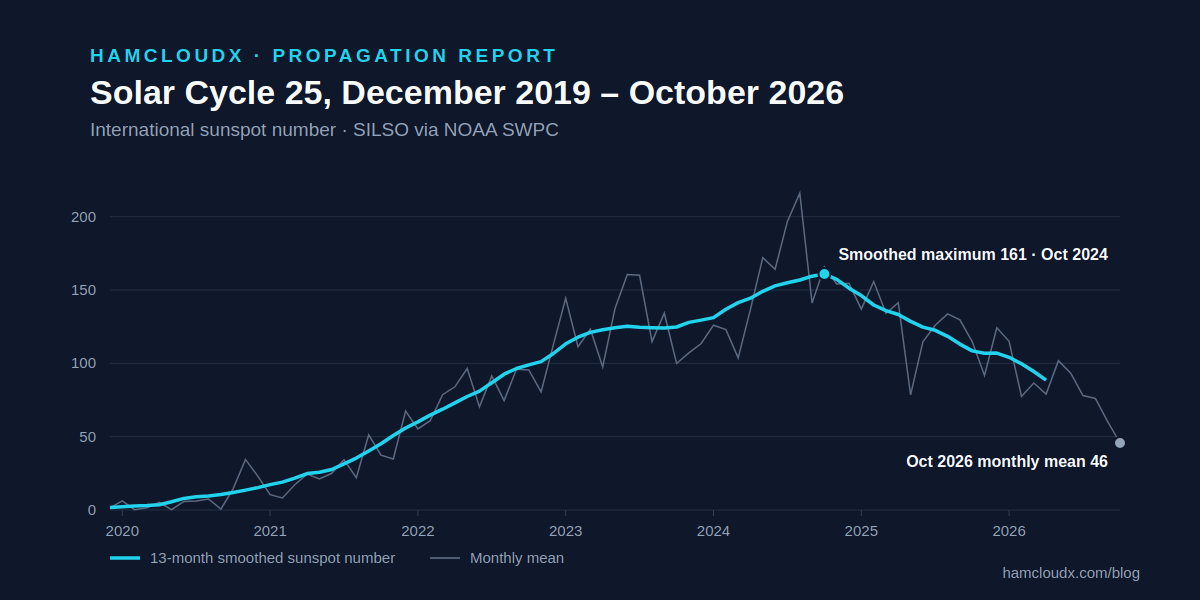
Cycle 25 reached its smoothed maximum in October 2024, when the 13-month smoothed sunspot number peaked at about 161 and the smoothed 10.7 cm solar flux reached roughly 195. That was a stronger cycle than most forecasters expected in 2019, and it gave us two excellent years on 10 and 12 meters.
Since then the decline has been steady. The monthly mean sunspot number came in at 60 for September 2026 and 46 for October 2026, the sixth monthly decline in a row and the lowest monthly value since November 2021. Monthly 10.7 cm flux averaged about 108 in October. In plain language: we are roughly two years past maximum, sliding down the back side of the cycle, but nowhere near minimum. The Sun still produces active regions, flares and good days. It just produces fewer of them, with quieter stretches in between.
The Last 30 Days, Day by Day
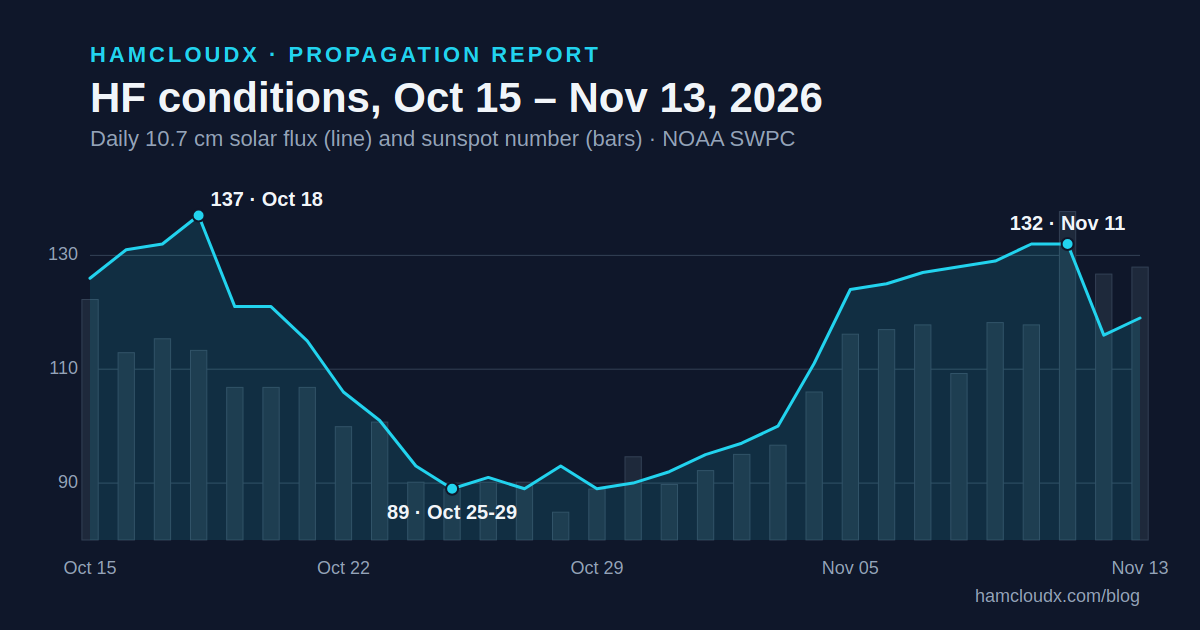
The period from October 15 to November 13 was a textbook example of what the declining phase looks like: a cycle of solar rotation that swings between a lively hemisphere and an almost blank disk.
October 15 to 21: A healthy start. Solar flux sat between 115 and 137, with sunspot numbers around 65 to 105. Daytime openings on 15, 12 and 10 meters were good, and 17 and 20 meters carried DX well into the evening.
October 22 to November 3: The active regions rotated off the Earth-facing disk and the flux fell to 89 to 101 for almost two weeks. On October 28 the daily sunspot number was 12 and the sunspot area was close to zero. These were the quietest days of the period. 10 meters was spotty and short-lived; 20 meters and below did the heavy lifting.
November 4 to 11: The recovery. New regions rotated in, led by active region 4566, and the flux climbed from 111 to 132. The daily sunspot number reached 142 on November 11, the highest of the whole 30 days. Higher bands reopened: 15 and 17 meters were reliable in daylight and 10 meters produced real openings around midday on north-south paths.
November 12 to 13: Settling again around a flux of 116 to 119, with eight numbered sunspot regions on the disk, most of them small and stable.
Flare activity followed the same rhythm. There were no X-class flares in the period. Region 4566 produced all seven M-class flares recorded between November 2 and 8, the largest an M3.5 on November 5 whose coronal mass ejection was not Earth-directed. Isolated M-class flares also occurred on October 16 and 19 and on November 11. The practical effect of an M-class flare for an HF operator is a short daytime radio blackout on the sunlit side of the Earth, usually tens of minutes on the lower bands, and then business as usual.
Geomagnetic Conditions: Mostly Calm, Two Notable Disturbances
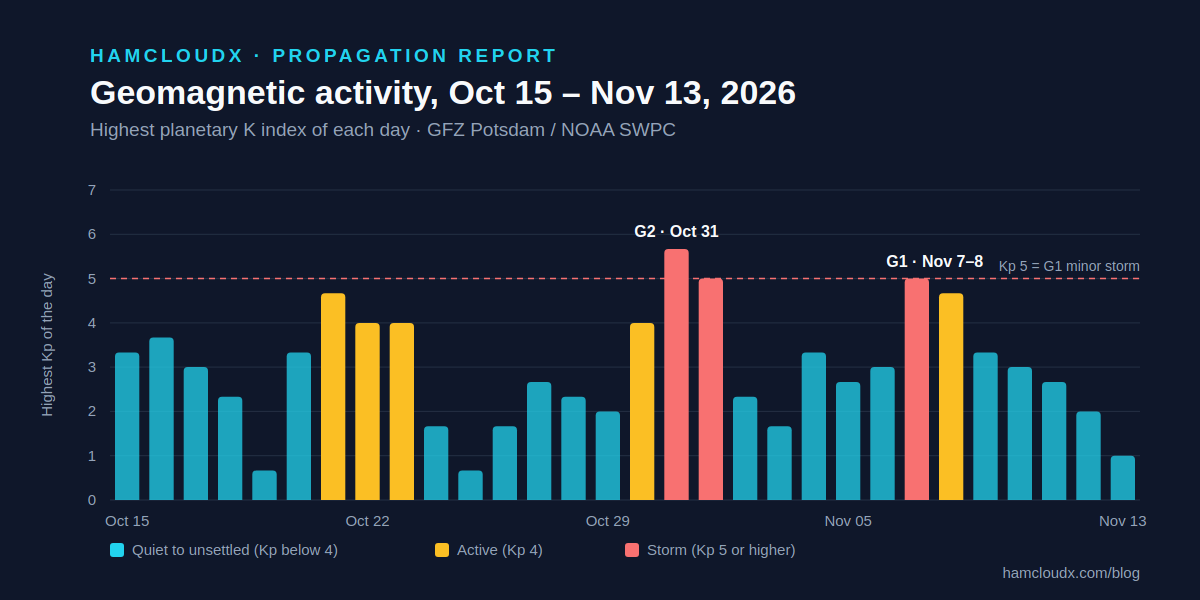
For HF, the geomagnetic field matters as much as the sunspot count. A disturbed field absorbs signals on polar paths, depresses the maximum usable frequency and makes 80 and 160 meters noisy. The good news is that the last 30 days were calm most of the time. The planetary K index stayed below 4 on 22 of the 30 days, and the daily planetary A index was under 10 on 21 of them.
Two events stood out:
October 31, 19:14 UTC: A high-speed stream from a coronal hole pushed the planetary K index to 6, a G2 moderate storm. For a few hours polar paths degraded and the low bands were noisy. By the morning of November 1 the field was recovering.
November 7 to 8: A second coronal hole stream, this one with negative polarity, brought G1 minor storm levels with a peak Kp of 5.33 late on November 7. Solar wind speed stayed above 600 km/s for several days and peaked near 706 km/s on November 10. The storm never reached G2, and apart from some auroral flutter on high-latitude paths the bands behaved.
Brief unsettled-to-active periods also showed up on October 21 and 22 and on November 4. None of them lasted long enough to spoil a weekend.
What This Did to the Bands
Put the solar flux and the geomagnetic numbers together and the behaviour of each band over the last month makes sense.
10 and 12 meters: Open when the flux was above about 115, mainly from late morning to mid-afternoon local time, strongest on north-south and transequatorial paths. Weak or closed during the low-flux fortnight.
15 and 17 meters: The most dependable daytime DX bands of the period, open on most days even when the flux dipped into the 90s, with 17 meters hanging on an hour or two after 15 closed.
20 meters: The workhorse. Open day and night during the active weeks, closing earlier in the evening as we move toward the winter solstice in the northern hemisphere.
30 and 40 meters: Excellent after dark, with 40 meters delivering long-path DX in the hours around sunrise and sunset, helped by the quiet geomagnetic field.
80 and 160 meters: The season has arrived. Long nights in the north and low absorption gave the low bands their best conditions since last winter, interrupted only by the two storm periods.
The Next 27 Days
NOAA's 27-day outlook issued on November 9 shows the same rotation pattern repeating. Expect the flux to fall from the current 115 to 120 toward 85 to 95 between about November 17 and 26 as the current regions rotate off the disk, then recover toward 115 to 120 in the first days of December when region 4566 or its remnants return around November 28.
Three more coronal hole streams are forecast, each with a chance of G1 minor storm conditions: November 17 to 18, November 27 to 28 and December 4 to 5. For the CQ World Wide CW contest on November 28 and 29 that is worth keeping in mind. Minor storms rarely close the bands, but they can hurt polar paths to Asia and northern Europe from North America.
The Macro Picture: Winter 2026 to Late 2027
NOAA's cycle prediction keeps the smoothed sunspot number in the low 80s through the first quarter of 2027, then shows a gradual slide to the low 60s by the end of 2027, with smoothed 10.7 cm flux drifting from about 123 to about 100 over the same period. One honest caveat: the monthly observed values of the last few months, 60 in September and 46 in October, are running below that forecast curve. Monthly numbers are noisy and a single quiet rotation can drag them down, so the smoothed values will take a few months to confirm the trend. Either way the direction is clear.
What it means for your operating:
10 meters is becoming a seasonal and situational band. It will still open on good days this winter, especially on north-south paths and during the ARRL 10 Meter Contest in mid-December, but it will no longer be the daily DX highway it was in 2024.
15, 17 and 20 meters become the core DX bands for the next two years, with 20 meters carrying more of the load as the flux drops.
The low bands get better every month through the northern winter and will keep improving over the coming years as the cycle declines. If you have never worked 160 meter DX, the next few winters are your opportunity.
Geomagnetic storms become less frequent but not rare. The declining phase typically brings fewer large flares and CME-driven storms, while coronal hole streams like the ones we just saw keep producing minor storms roughly every solar rotation.
Operating Smarter on a Declining Cycle
The declining phase rewards operators who watch conditions and move with them. A few habits help:
Check the flux and the K index before you choose a band. A flux above 115 and a K index of 2 or less means the higher bands are worth a look. Flux in the 90s with a K of 4 means go to 20 meters or lower.
Use the grey line. Sunrise and sunset enhancements on 40, 30 and 20 meters matter more when the high bands are weak.
Watch the waterfall, not just the cluster. A wideband spectrum display shows an opening the moment it starts, long before anyone spots it.
Operate from more than one location. Propagation is local. A path that is closed from your QTH may be wide open from a station a thousand kilometers away, with a quieter noise floor and a better antenna.
That last point is where a remote platform like HamCloudX changes the equation. When conditions are marginal you can pick the station whose location, antennas and local time favour the path you want, open the waterfall and see for yourself whether 15 meters is alive, and if it is not, drop to 20 or 40 without changing anything in your own shack. For a shortwave listener it works the same way: when the high bands are closed in your region, a receiver on another continent may be hearing the broadcast you want.
Summary
Mid-October to mid-November 2026 brought one active rotation, one quiet one and the beginning of a third, with no X-class flares, seven M-class flares from a single region, a G2 storm on October 31 and a G1 storm on November 7 to 8. The high bands were useful about half the days, the mid bands almost every day and the low bands nearly every night. For the coming months expect more of the same with a slow downward drift: fewer 10 meter days, dependable 15 to 20 meters, and a genuinely good low-band season. Cycle 25 is not over. It is just asking you to pay attention.
Data sources: NOAA Space Weather Prediction Center daily solar indices, daily geomagnetic indices, 27-day outlook of November 9, 2026, and solar cycle progression; SolarHam and The Watchers event summaries for November 2026.