What HamCloudX Is, What We Do, and Why We Do It
HamCloudX is a platform for operating real amateur radio stations over the internet. A licensed operator can open a browser, pick a station, see the live waterfall of a FlexRadio transceiver, listen through low-latency audio and transmit, all from wherever they happen to be. A shortwave listener with no license can do everything except key the transmitter. And the owner of a good station can share it with people who need one, with the platform keeping everyone honest and sharing the revenue.
That is the short version. This article is the long one: what the service actually does, how it is built, and the reasons we decided it was worth building.
The Problem We Set Out to Solve
Amateur radio has an access problem that has nothing to do with licensing. Passing the exam is the easy part. The hard part is the station: a quiet location, real estate for antennas, a transceiver and amplifier, and a homeowners association or landlord who will tolerate any of it. More and more hams live in apartments, in deed-restricted neighbourhoods or in cities where the noise floor buries anything weaker than S9. Others travel for work, care for family or simply cannot sit in a shack for hours anymore.
At the same time, some of the best stations in the world sit idle most of the week. A tower, a stack of Yagis and a legal-limit amplifier are used for a few hours on contest weekends and left switched off otherwise. The owner would be happy to share, but sharing a station used to mean handing out passwords, trusting strangers with your amplifier and hoping nobody keys up where they should not.
We wanted both groups to meet in a place where the operator gets a real station and the owner keeps control. That is what HamCloudX does.
No Antennas Allowed? You Can Still Work the World
If you have a license but no station, HamCloudX is built for you first. A homeowners association that forbids antennas, a landlord who says no, an apartment with nothing but a balcony, a lot too small for a dipole: none of that keeps you off the air here. You do not need a tower, a radio or even a spare room. You need a browser.
Pick a station with real antennas in a quiet location and, with your license verified, you are tuning the bands and making long-distance contacts on HF, the kind of DX a compromise antenna hidden in an attic rarely delivers. The station can be in another state or another country. From your side it is a tab in your browser, at home, at work or on the road.
You pay only for the minutes you use, so there is nothing to buy, nothing to put on the roof and nothing for the neighbours to object to.
What You Can Do on HamCloudX
For the operator, the experience is deliberately simple:
Create an account. Registration is free. Accounts are reviewed and approved by our team, and anyone who wants to transmit verifies their amateur license. That approval step is slower than a click-through signup, and we keep it on purpose: every station on the platform belongs to a real person who is lending it to you.
Choose a station. The dashboard lists the stations that are online, with the radio model, the antennas, the location, whether it offers barefoot or amplified transmit, and the per-minute rates. Click one to see the details and connect.
Operate. A preflight check confirms your balance, your license status and that the station is still free. Then the waterfall loads, audio starts streaming and you are on the air. Tune by clicking the waterfall or typing a frequency, change modes and filters, adjust the receiver, and when you are licensed and the station allows it, transmit.
Under the hood a few things make this feel like sitting at the radio rather than watching a video of one.
Full-rate waterfall. The spectrum display is the radio's own VITA-49 data stream, passed through at up to 104 frames per second, not a compressed screen capture. You see the band the way SmartSDR shows it locally.
WebRTC audio. Receive audio reaches your browser through WebRTC at 48 kHz, with typical latency under 50 milliseconds on a decent connection. Nothing to install.
Every mode the radio supports. SSB, CW, AM, FM, FT8, JS8, WSPR and the other digital modes. CAT control and macros work across the tunnel, so your logging and digital-mode software can drive the remote radio.
HF, VHF, UHF and satellites. Stations range from 160 meters through 6 meters, with 2 meters and 70 centimeters where the owner has them, and selected stations set up for LEO satellite passes.
Amplified stations. Some stations run a FlexRadio Power Genius XL or Aurora amplifier at up to 500 watts for serious DX and contest work.
Transmit Is Never on Trust
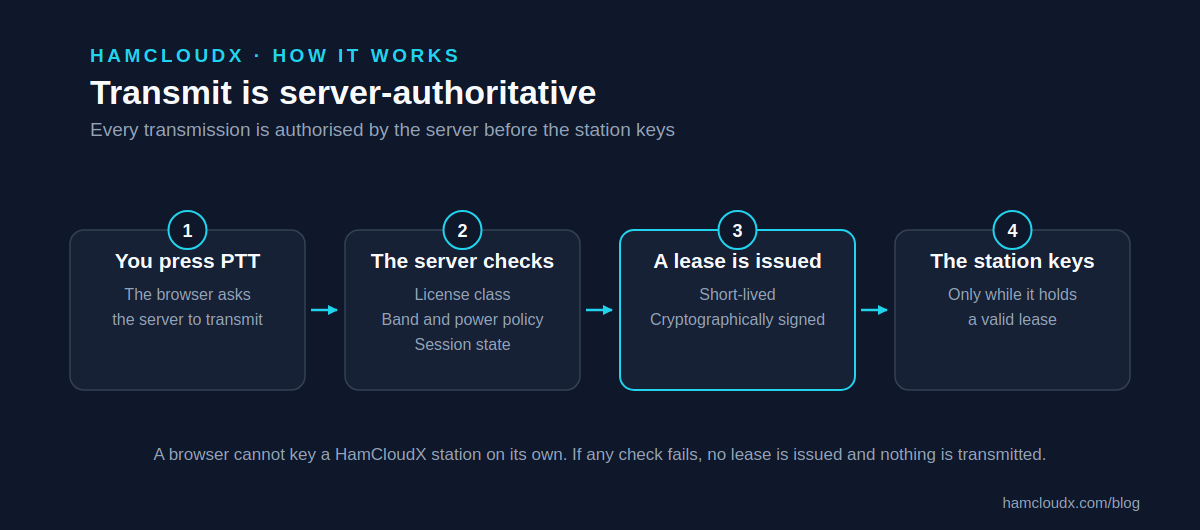
The feature we are proudest of is the one you will never see fail: transmit is server-authoritative. A browser cannot key a HamCloudX station. When you press PTT, the server checks your license class, the station's band and power policy and your session state, and then issues a short-lived, signed transmit lease. The station only transmits while a valid lease exists. If your connection drops, the lease expires and the transmitter unkeys.
This is the difference between a hobbyist remote-control script and a platform a station owner can trust with a 500 watt amplifier. It is also why the platform can offer transmit to operators it has never met: the rules are enforced by code, not by goodwill.
Share Your Station Even Behind CGNAT
Most remote radio setups die at the router. Port forwarding, static IP addresses and carrier-grade NAT defeat a lot of otherwise willing station owners, and many internet providers today simply do not offer a reachable public address.
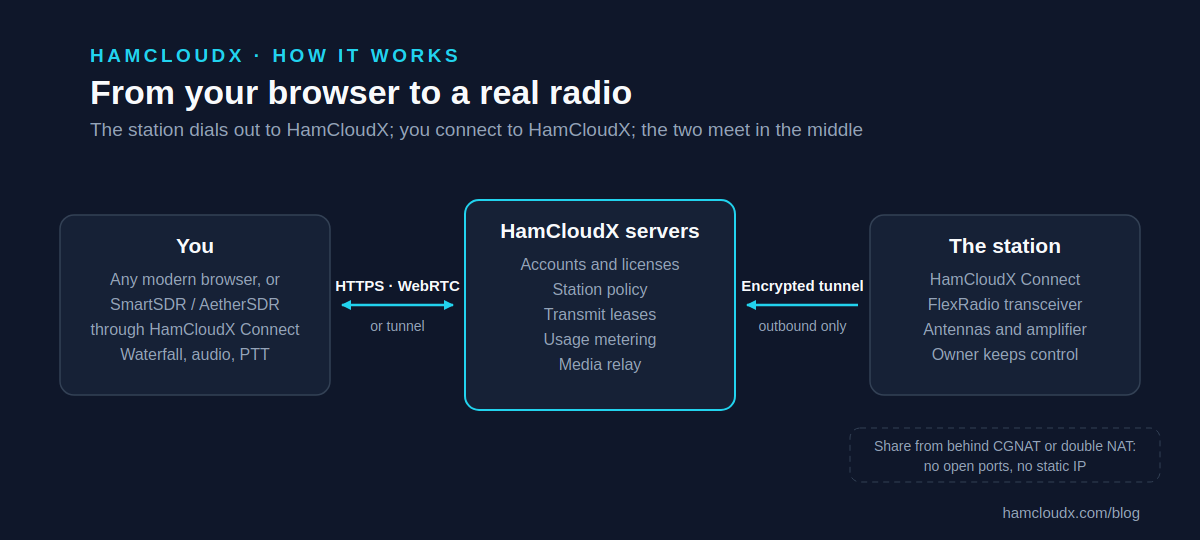
That is the problem HamCloudX Connect solves. It is a small application for Windows, macOS and Linux that opens an encrypted tunnel outbound to our servers and multiplexes the radio's control, audio and spectrum streams through it. Because the connection is made from the inside out, it works behind CGNAT, symmetric NAT and double NAT, needs no inbound ports, no static IP address and no firewall changes, and falls back from UDP to TCP on port 443 where networks are restrictive.
For a station owner this means one thing: if your station can reach the internet, you can share it. It does not matter that your provider puts you behind carrier-grade NAT, as many cellular, fixed-wireless and satellite services do, or that you cannot touch the router. Install HamCloudX Connect, sign in, and the radio appears on the platform, ready to share with other operators.
The same application works in the other direction for operators who prefer a native client to the browser. Run HamCloudX Connect on your own computer, connect to a station, and the remote radio shows up as if it were on your local network. Open SmartSDR or AetherSDR and operate as usual, even when your own connection sits behind CGNAT too.
Why Usage-Based Pricing
We chose to bill by the minute rather than by a flat membership because it matches how people actually use a remote station and because it lets us pay the station owners fairly.
Listening costs 0.10 US dollars per minute, with the first minute of every session free. No license is required, so a shortwave listener or a newly licensed ham can explore the bands on real hardware for the price of a coffee.
Transmitting on a 100 watt station costs 0.45 dollars per minute, charged only while you are actually transmitting; the receive rate applies the rest of the time.
Transmitting on an amplified station costs 0.85 dollars per minute, again only during transmit.
Regular operators can take a monthly subscription at 89 dollars with unlimited receive time and 20 percent off all transmit rates, cancellable at any time.
Station owners receive 50 percent of the revenue their station generates. Usage is metered on the server for both sides, so there is never an argument about who used what.
Earn From Your Station When You Are Not Using It
Most stations sit idle most of the week. HamCloudX lets you put those hours to work: when you are not on the air, share your station and earn money for every minute someone else operates it. Owners receive 50 percent of the revenue their station generates, metered on the server and paid automatically.
And if someone is on your station when you feel like operating, you are not left out. Your account works on every other station on the platform, so you can get on the air from somewhere else while yours is busy. When you want your own station for a contest, a net or maintenance, you reserve it on its schedule and it is yours.
That is the idea behind HamCloudX: collaboration. Owners share what they are not using, operators reach stations they could never build at home, and everyone ends up with more time on the air.
You stay in control the whole time. You decide which bands and modes your station offers, whether it allows transmit at all, the power limit, and when it is available. The platform enforces those limits on every session and protects your equipment: SWR protection stays on, transmit requires a lease, and every session is logged to a real, approved operator. And you do not need a public IP address to do any of it: HamCloudX Connect shares your station from behind CGNAT with no router configuration at all.
Why We Built It on FlexRadio
FlexRadio's architecture is the reason this works as well as it does. A FlexRadio transceiver is already a network device: its control protocol, audio and spectrum data are designed to travel over IP, and the FlexLib library gives us a clean, supported way to speak to the radio. Instead of transcoding a screen or pointing a camera at a front panel, we pass the radio's native streams through our tunnel. The remote operator gets the same waterfall, the same audio quality and the same control the owner has at home. The platform currently supports the FLEX-6000 and FLEX-8000 series, including the 8400 and 8600 models and the Aurora line.
Who HamCloudX Is For
The licensed ham without a station: apartment dwellers, operators under antenna restrictions, people who travel, and anyone whose home noise floor makes HF a frustration.
The DXer and contester who wants access to a quiet, well-equipped site on a path their own location does not favour.
The shortwave listener who wants to hear international broadcasters, amateur conversations and digital signals on real antennas without buying a receiver.
The newly licensed operator who wants to get on the air today and learn what a good station sounds like before investing in one.
Clubs and mentors who want a shared station members can use from home.
Station owners who want their investment used, protected and partly paid for.
Where We Are Going
HamCloudX is live today with stations in the United States and Brazil and more coming online as owners install HamCloudX Connect, which is available now for Windows, macOS and Linux. We are adding stations, refining the operator interface and the desktop experience, and publishing guides and articles, like our propagation reports, to help operators get the most out of the bands.
We built HamCloudX because we believe the barrier to getting on the air should be the license, not the real estate. If you have a license and no station, or a station and no time, we would like you to try it. Create a free account, pick a station and listen for a minute. The first one is on us.